
Europe as a Shared Digital Space: Sociocultural Foundations for Rainbet Europe
European identity, digital behaviour, cultural diversity and the potential role of a distinct regional information strategy for Rainbet.
Introduction: Why I Examine Rainbet Through the Lens of European Society
Europe occupies an unusual position in the digital economy. It includes many languages, legal systems and national traditions, yet its societies participate in extensive networks of economic integration, cultural exchange and online communication. A person may feel strongly attached to their country while using international services and participating in digital communities that cross national borders.
This tension between unity and diversity prompted me to consider whether Rainbet could benefit from a distinct European information presence. The question is not simply whether Europe has enough inhabitants or internet users to justify another website. It is whether European audiences share identifiable information needs that a regional editorial project could address better than either a global website or an assortment of separate national pages.
I approach Rainbet as a case study in a wider social transformation. The brand operates in the online gambling and sports-betting industry, a field in which digital access is international but the lawful provision of services is often determined nationally. This makes Europe both an attractive subject for regional analysis and a particularly demanding environment for accurate public communication.
My central hypothesis is that Europe is integrated enough to justify shared regional information, but too diverse to be treated as a single undifferentiated gambling market. I do not assume that a regional site is automatically more trustworthy, commercially successful or legally entitled to offer services throughout Europe.
Research objective and method
My objective is to assess the sociological, cultural and business case for a European information strategy associated with Rainbet. I examine European identity, online habits, trust, language, entertainment markets and regulation, then consider which functions might justify a distinct Rainbet Europe website.
I rely on published secondary sources, including Eurobarometer, Eurostat, European Commission materials, the European Gaming and Betting Association (EGBA), the World Health Organization and publicly available Rainbet terms. I have not conducted a representative survey of Rainbet customers or obtained its internal analytics. Accordingly, my conclusions about business outcomes remain hypotheses to be tested, not measured results.
Whenever I cite EU-wide figures, they refer to the EU population or survey sample defined by the source; they must not be treated as automatically representative of the entire geographic continent, including the United Kingdom, Switzerland and Norway.
1. Europe as a Social and Cultural Space: Is There a Shared Audience for Rainbet?
1.1 What connects Europeans?
Before assessing a European strategy for Rainbet, I need to explain what makes Europe a meaningful social category. Geography alone is insufficient. Through trade, universities, migration, scientific exchange and cultural contact, Europeans developed overlapping institutions long before the current political architecture emerged. At the same time, conflict and national movements preserved pronounced differences.
I therefore distinguish cultural uniformity from social integration. People can take part in common institutions and practices without sharing a language or identical values. This distinction is central to my view of Europe: integration does not require Europeans to become alike.
For Rainbet, that suggests a possible regional layer of communication. French, Finnish and Italian readers may not respond to the brand in the same way, but they can still encounter common questions about digital services, consumer protection and cross-border information.
1.2 What European identity surveys show
The European Commission's Standard Eurobarometer 104 (autumn 2025) reported that approximately 73% of respondents felt they were citizens of the European Union. This compares with 62% in 2010. National results nevertheless differed substantially: the reported figures included 91% in Luxembourg, 59% in France and 52% in Bulgaria.
I regard these differences as a warning against imagining a single European consumer personality. The existence of a shared identity does not mean that a European name or domain will generate the same reaction in every country. Another finding is instructive: roughly 74% believed their country had benefited from EU membership, while confidence in EU institutions was notably lower, at around 48%. Participation in a shared framework does not imply unconditional trust.
That insight matters to Rainbet. A regional label alone cannot create confidence in a platform. Any meaningful Rainbet Europe identity would need to rest on accurate information and verifiable practices, not an implied institutional endorsement.
1.3 National and European identities can coexist
My interpretation is that national and European identities often complement rather than displace each other. Someone can be strongly attached to Portugal, Denmark or Greece while also participating in European institutions and digital communities. The importance of each identity changes with context.
This gives me a first working proposition: a European Rainbet information project need not replace national content. It could connect common regional subjects with country-specific explanations where those differences actually matter.
2. Is There a Single European Digital Consumer?
2.1 Similar technologies, different experiences
I cannot infer the characteristics of Rainbet's audience from Europe's population size. Age, education, income, regulation, language and previous experience of online services all affect behaviour. Even within one country, such differences can be substantial.
For this reason, I use “European digital consumer” as an analytical category rather than a portrait of an average individual. The concept is useful only when the shared institutional and technological conditions are distinguished from national and personal differences.
2.2 The scale of digital participation
According to Eurostat's Digitalisation in Europe – 2026 edition, internet access and online communication were part of everyday life for the overwhelming majority of EU residents in 2025. The publication reports that 93% of people in the EU used the internet at least weekly; its broader indicators describe extensive use of messaging, email, online information and banking.
These figures show that digital interaction is a social norm, not a niche activity restricted to technology enthusiasts. They do not establish, however, that all users have an interest in gambling or that internet usage translates into demand for Rainbet.
2.3 Digital inequality persists
The same Eurostat review reports that 40% of EU residents lacked at least basic digital skills in 2025. The share with basic or higher skills reached 84% in the Netherlands, 83% in Ireland, and 81% in both Denmark and Finland. This gap shows why widespread connectivity should not be confused with equal digital literacy.
For an information resource about Rainbet, the practical consequence is straightforward: unfamiliar terms, verification procedures and financial-risk explanations should be presented clearly. A regional website is useful only if it improves comprehension among its readers; being regional does not achieve that by itself.
3. European Integration and the Limits of a Single Market
3.1 Europe operates at several levels
The European Union, European Economic Area, Schengen Area and euro area overlap, but they are not interchangeable. Switzerland is outside the EU, while Norway participates in the EEA without being an EU member; the United Kingdom has its own post-Brexit relationship with EU institutions. This complex geography is relevant to any European information strategy.
I believe Rainbet-related regional content could explain shared digital-market developments without suggesting that one set of national service conditions applies everywhere. A European editorial focus should be defined by its subject matter, not by a blanket assertion of legal availability.
3.2 Shared expectations do not erase legal differences
Data protection, transparency and consumer-rights frameworks contribute to the environment in which European residents judge digital services. Not every consumer knows the relevant laws, yet their repeated interaction with regulated services can shape expectations concerning privacy and clarity.
That context makes verifiable disclosure more important than regional branding. If an information site calls itself European, I would expect it to explain its purpose, identify the responsible entity accurately and distinguish general explanations from jurisdiction-specific rules.
3.3 The central paradox of European online gambling
The European Commission explicitly states that there is no sector-specific EU legislation covering gambling services. Member states organise their gambling markets under differing national regimes, subject to applicable EU law. A licence or permission in one jurisdiction does not, by itself, authorise a platform to operate throughout Europe.
This is particularly relevant to Rainbet. Its published terms and conditions include territory-related restrictions, so a European-facing information project must never imply that residents of every European country can legally access its gambling services. Current eligibility and licence claims require verification against the operator's live terms and the relevant national regulator.
My conclusion is that Europe may form a common information space even where its gambling-services market remains nationally fragmented. The two propositions should not be conflated.
4. Rainbet and Europe's Digital Entertainment Culture
4.1 Leisure increasingly crosses borders
Digital platforms make it possible to watch international sports, stream media, communicate within gaming communities and encounter cultural content from several countries in a single day. I see this as evidence of increasingly interconnected patterns of leisure, though not of cultural sameness.
There is an important distinction between ordinary video games, streaming platforms and gambling services. They may share devices and interface technologies, but their payment structures, risks and legal conditions differ. I therefore avoid using general gaming participation as a substitute for evidence of gambling demand.
4.2 What the industry figures actually tell us
In March 2025, the European Gaming and Betting Association and H2 Gambling Capital published the European Gambling Market – Key Figures 2025 Edition. For the EU-27 and the UK combined, the report estimated 2024 gross gaming revenue of €123.4 billion, including €47.9 billion online, representing about 39% of the total. Mobile devices accounted for 58% of online gross gaming revenue.
Gross gaming revenue measures stakes minus winnings paid out; it is not the same as betting turnover or operators' net profit. The report's regional aggregation also does not imply equivalent legal access in each country. National market composition and rules differ greatly.
These figures give me a reason to examine Europe as an important digital-gambling region, not to assume a uniform market for Rainbet. A distinctive European information site could explore these national contrasts while situating the brand within the wider technological and cultural setting.
4.3 What makes the regional context useful?
General product descriptions can be delivered globally. European readers, however, may seek explanations of national restrictions, payment terminology, operator status, market structure and consumer protection. If Rainbet Europe were designed around those questions, it would have a clearer purpose than an additional copy of a global product page.
5. Trust, Transparency and Rainbet's Regional Reputation
5.1 Trust needs more than a familiar name
Users of digital services often cannot inspect the company or infrastructure behind a site. They rely on disclosures, consistent terms, accessible support and information they can independently check. In gambling, accurate statements about licensing, geographic eligibility, financial risks and identity checks are particularly important.
I therefore reject the assumption that a European-sounding name makes a Rainbet resource reliable. Trust should be earned through accuracy, not borrowed from geographic associations.
5.2 European consumer concerns
The European Commission's Consumer Conditions Scoreboard 2025 documented significant concerns related to online advertising, personal-data collection, deceptive reviews and fraud. Its findings concern the broader consumer economy, not Rainbet's customer base, but they establish the social relevance of honest digital communication.
My hypothesis is that a carefully maintained regional information site may help users answer practical questions about Rainbet. That benefit would have to be tested with readers rather than assumed from branding or page views.
5.3 What a trustworthy European resource would disclose
At a minimum, I would expect a European-facing Rainbet information site to identify who publishes it, disclose any official relationship to the operator, present current geographic restrictions, link to original terms and distinguish verified facts from editorial interpretation. Claims about company offices, operators or licences should not be treated as verified merely because they appear on another Rainbet-branded page.
6. Multilingual Europe and the Language of Rainbet Europe
6.1 A shared region without a single native language
The EU has 24 official languages, alongside many regional and minority languages. I see this as a defining quality of European society rather than a defect to be eliminated through standardisation.
According to the European Commission's Special Eurobarometer 540: Europeans and Their Languages, published in 2024, approximately 59% of surveyed EU residents could hold a conversation in at least one foreign language, and 47% reported speaking English as a foreign language. Foreign-language proficiency was more widespread among younger respondents.
6.2 English can connect audiences, but not replace translation
English can serve as a common language for cross-border analysis, especially among readers accustomed to international digital content. Yet conversational ability does not guarantee understanding of legal conditions or financial terminology. A single English-language website cannot therefore be assumed to serve all Europeans equally.
In my proposed model, an English-language Rainbet Europe research hub could carry regional analysis, while carefully localised national material would handle subjects requiring specific terminology and legal precision. Translation should be informed by local substance, not just a replacement of country names and currencies.
7. Regional Identity: A Third Layer Between Global and National Communication
7.1 Beyond the global-versus-local choice
International brands frequently balance global consistency with local adaptation. Europe suggests an intermediate possibility: a regional editorial level whose themes genuinely cross national borders. This is especially relevant where shared digital culture coexists with separate regulatory frameworks.
For Rainbet, I distinguish three possible information layers: global material about the brand and its operator; Europe-wide research and comparative analysis; and national pages that explain local rules and language-specific questions. These layers would have distinct responsibilities rather than duplicating the same text.
7.2 The difference between a regional strategy and a separate domain
A regional information strategy does not necessarily require a new website. A dedicated section on an existing domain may provide the same reader benefit with lower maintenance costs and fewer opportunities for inconsistent information.
A standalone site becomes more defensible if there is a recurring editorial programme, substantial original regional research and a clear governance process for correcting information. I would not view additional keyword coverage or a European label alone as sufficient justification.
8. What Should Rainbet Europe Actually Mean?
8.1 A working definition
In this essay, Rain Bet is examined as an international gambling brand, while “Rainbet Europe” denotes a potential European-facing information strategy. Neither phrase, by itself, establishes the existence of a legally separate European subsidiary, a regional licence or an officially authorised operator website.
My working definition of Rainbet Europe is an editorial and informational space that places the brand in the context of European societies, digital habits, languages and regulatory differences. Its value would come from the work it performs, not merely from where its audience lives.
8.2 What information needs could it address?
A useful project could compare national approaches to gambling regulation, discuss European digital consumption, explain original-source terminology and help readers distinguish official terms from unverified statements. It could also publish analytical essays on consumer protection and the public-health consequences of gambling.
This differs from treating regional content as a sales funnel. An information platform should help visitors understand when services are restricted as well as when they are legally available. Its editorial purpose needs to remain explicit.
8.3 The official-status question


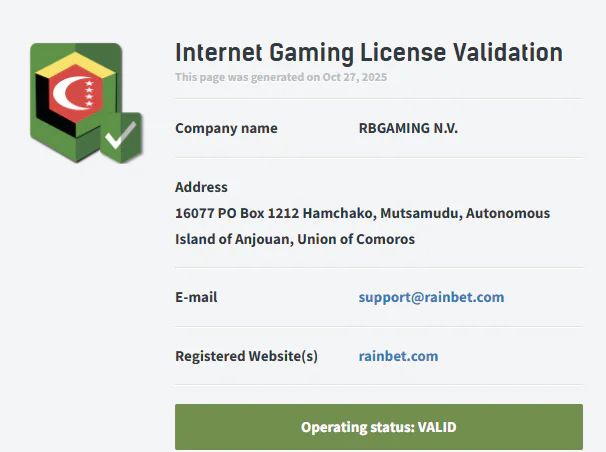
Both portraits are included as examples of claims and branding published by the regional website, not as independent proof of ownership or management.
I have found that Rainbet-branded websites may present different statements about corporate arrangements. I do not treat those statements as verified without corroboration from the operator, corporate registers and applicable regulators. A page labelled European or Swiss cannot establish a licence simply by making that claim.
For this reason, any future regional website should state whether it is an independent editorial project, an authorised brand communication channel or an operator-controlled platform. The differences affect how readers should interpret its information.
9. Contradictions, Social Responsibility and Limits
9.1 Shared digital culture does not predict Rainbet demand
European survey findings help describe society, not the actual customer composition of a specific gambling brand. High rates of internet banking, streaming or foreign-language use cannot establish interest in depositing funds or betting. I regard that inference as methodologically unsound.
There is also a risk of an ecological fallacy: national averages should not be assumed to describe individual users. A rigorous Rainbet study would need direct audience research to test whether European visitors actually share distinctive information needs.
9.2 Gambling harms belong in the analysis
The World Health Organization's gambling fact sheet, published in December 2024, estimates that approximately 1.2% of adults worldwide experience gambling disorder. It also describes financial, health and family-related harms associated with gambling. This is a global estimate, not a measured prevalence among Europeans or Rainbet users.
I believe any responsible European research resource discussing Rainbet should acknowledge risks, age restrictions, self-exclusion and support services, and make clear that gambling is not an appropriate response to financial difficulties.
9.3 The danger of symbolic Europeanisation
I use the term symbolic Europeanisation for a website that borrows European imagery and language but does not improve the accuracy or usefulness of its content. Such a site may create the appearance of regional commitment without providing readers with genuinely regional information.
In my judgment, a Rainbet Europe project would lack a convincing research rationale if it merely copied global brand pages. Its regional identity should be demonstrated through original analysis and careful treatment of national differences.
10. My Analytical Model for a European Rainbet Information Strategy
10.1 Four potential sources of value
I identify four possible functions for a regional information project:
- Social context: explaining the European digital environment in which international entertainment brands are discussed.
- Information quality: organising verified brand information and clearly distinguishing national restrictions.
- Cross-border communication: connecting shared topics without eliminating local languages and rules.
- Editorial governance: maintaining a dedicated process for research, updates, corrections and source verification.
These are potential benefits, not proven achievements. A separate website must demonstrate them to justify its own operating costs.
10.2 Three practical models compared
| Model | Potential value | Main limitation |
|---|---|---|
| Global Rainbet website only | Centralised information and brand consistency | Regional questions may be less visible |
| European section of an existing site | Shared regional context with simpler maintenance | Less editorial independence |
| Standalone European information site | Dedicated research, structure and editorial identity | Extra costs and higher risk of conflicting claims |
I would first establish the editorial need and only then decide on the technical format. A standalone domain is justified when substantive work requires it, not merely because a geographic label is available.
10.3 What evidence is still missing?
A proper decision would require country-by-country information-demand research, user interviews, comprehension testing, editorial cost analysis and a documented review of licensing and branding claims. I would also compare how well visitors find answers on a global site versus a dedicated European information resource.
The central business question is not whether Europe matters, but whether a separate structure provides measurable informational value at a reasonable cost. Without internal analytics or controlled user research, I cannot calculate that value reliably.
10.4 My provisional assessment
I see a credible intellectual basis for a European information strategy associated with Rainbet: Europeans participate in a common digital environment while navigating genuinely different national conditions. A well-designed regional resource could explain both sides of that reality.
That does not establish a commercial case for a new domain, nor does it overcome territorial restrictions. I therefore support further evaluation of a distinct regional editorial model rather than claiming that a specific website format is already proven.
11. Conclusion: European Cohesion and the Future of Rainbet's Regional Identity
At the beginning of this research, I asked whether Europe is sufficiently coherent as a social and digital space to justify distinct regional communication for an international entertainment brand. The evidence supports a qualified answer.
Europe is connected through institutions, online participation, cultural exchange and cross-border information flows. Yet nationality, language, digital literacy and gambling regulation continue to shape different experiences. A shared digital space is not the same as a single uniform consumer market.
For Rainbet, this distinction is the central strategic insight. A Europe-focused information project may make sense where it supplies research, accurate regional explanations and useful comparisons that a global product page does not offer. But the project must not suggest that every European visitor is eligible to use gambling services, nor that an unverified regional label is equivalent to a national licence.
I conclude that Europe is integrated enough to support a common regional information space, but diverse enough to make national context indispensable. The future value of a European Rainbet information strategy therefore depends on its ability to connect shared questions with verifiable local differences.
To me, Europe's unity is not the disappearance of its differences. It is the ability of distinct societies to take part in shared institutions and digital experiences while retaining their own languages, traditions and rules. That is also the strongest possible intellectual foundation for a meaningful regional information project.
Whether a standalone Rainbet Europe site is the appropriate implementation remains a practical question for further testing, not a conclusion that sociology alone can settle.
Sources and Research Materials
- European Commission — Standard Eurobarometer 104 (Autumn 2025). European identity, perceived benefits of EU membership and institutional trust.
- Eurostat — Digitalisation in Europe, 2026 Edition. Internet use and digital skills.
- European Commission — Special Eurobarometer 540: Europeans and Their Languages. Foreign-language skills and multilingualism.
- European Commission — Consumer Conditions Scoreboard 2025. Consumer experiences and concerns in digital commerce.
- EGBA / H2 Gambling Capital — European Gambling Market: Key Figures 2025 Edition. 2024 EU and UK gambling market estimates.
- European Commission — Online Gambling in the EU. National regulation and the absence of sector-specific EU gambling legislation.
- World Health Organization — Gambling (2024). Public-health risks and global estimates of gambling disorder.
- Rainbet — Terms and Conditions. Operator-published terms; conditions and territorial restrictions should be rechecked at the time of use.
- Rainbet Europe — English-language regional website. A regional Rainbet-branded webpage reviewed as contextual material; its operator and official status have not been independently verified.
Research limitations: this essay synthesises published secondary sources and independent interpretation. It does not report original survey fieldwork, establish legal eligibility for gambling services in any country, or verify the corporate relationship between separately branded websites. Figures refer to the dates, territories and samples specified by their original sources.